
APRA Could Kickstart the Australian Housing Market WITHOUT the RBA Cutting Interest Rates!
Everyone focuses on the RBA, but there’s another powerful player that can influence the housing market independently of interest rate decisions: APRA (Australian Prudential Regulation Authority).
What APRA Does and Why It Matters
APRA was established to protect the financial stability of Australia’s financial institutions and has several powerful tools to control housing finance.
For example, in 2014, APRA introduced a benchmark limiting annual growth in investor housing lending to 10%.
What Is the Mortgage Serviceability Buffer?
But arguably its most powerful tool is the mortgage serviceability buffer.
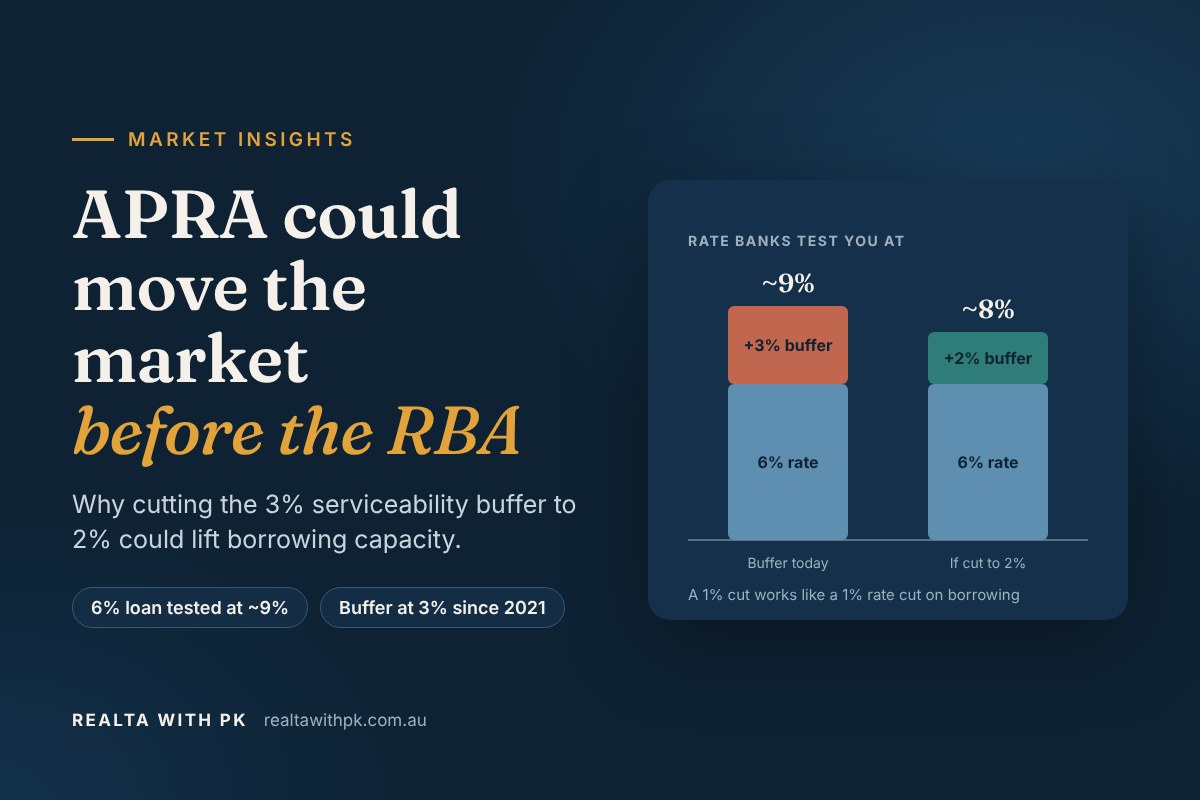
Currently, banks must assess borrowers’ ability to repay their mortgages at an interest rate 3% higher than their actual mortgage rate.
A Short History of APRA's Serviceability Buffer
Here’s the history:
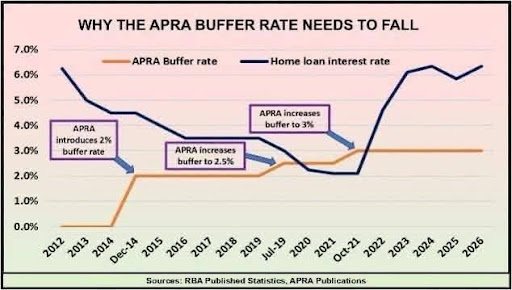
* 2014: APRA introduced a 2% serviceability buffer.
* 2019: The buffer increased to 2.5%.
* 2021: It increased again to 3%, when mortgage interest rates were around 2%.
* Today: Despite mortgage rates rising significantly since 2021, APRA has maintained the 3% buffer.
Why Hasn't APRA Cut the Buffer?
The original purpose was to protect banks against borrowers defaulting if interest rates increased.
But here’s my question: Why hasn’t APRA reduced the buffer now that interest rates are substantially higher?
For borrowers paying around 6% interest, a 3% buffer means being assessed at approximately 9%, close to 10%, a level few are forecasting.
Why it’s time to consider cutting the buffer from 3% to 2%:
✅ A 1% reduction could boost borrowing capacity substantially, with a similar serviceability assessment effect to a 1% interest rate reduction.
✅ First home buyers, upgraders and property investors could all benefit.
✅ Existing homeowners and investors could potentially refinance and access additional borrowing capacity.
✅ Housing demand could increase without the RBA needing to cut actual interest rates, although additional lending could still influence inflation.
APRA vs the RBA: A More Direct Lever
Unlike the RBA’s broad interest rate tool, APRA can adjust lending restrictions more directly.
A reduction from 3% to 2% could be a powerful catalyst for the next Australian housing market upswing.
And that could benefit homeowners, investors, banks and government revenues.
Book a Free Discovery Call With Realta with PK
If you would like to understand which markets our research team is currently active in and whether a property in Melbourne or elsewhere in Australia makes sense for your situation right now, book a free 60-minute Discovery Call with our team.
There is no obligation and no cost. Just an honest conversation about your goals, your budget and what the data actually shows about where the best opportunities are right now.
Co-Founder | The Educator & Mentor
I’m also a property investor with a $27m+ debt-free portfolio of residential & commercial property, generating over $300k+ net annual passive income.
I help people from all over Australia, by accessing a unique strategy that combines high growth high cashflow residential property, alongside highly profitable property development projects to help accelerate their passive income. I typically work with families, young over-achievers, and new Buyers Agents who want a predictable, DATA-led system to grow wealth and Passive Income.